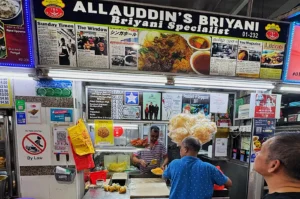
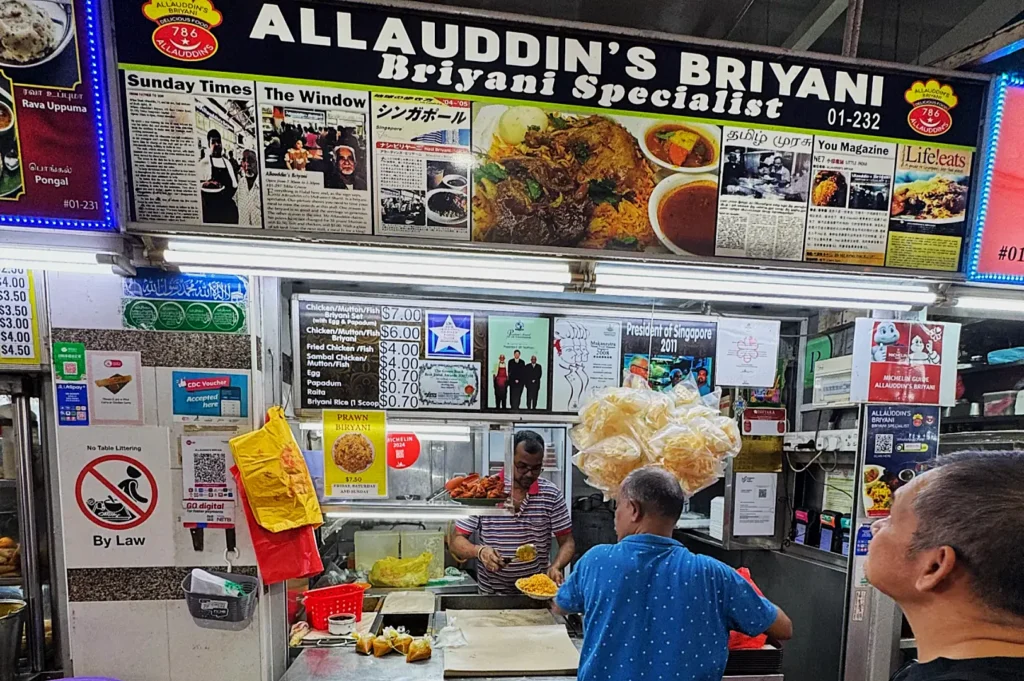
Tekka Centre is loud before you even step inside. The wet market hums with the slap of fish on ice, the call of vendors, the squeak of trolley wheels over damp tiles. Upstairs, the air shifts. Spice replaces brine. Somewhere in that thick, fragrant heat, a queue forms outside a stall that has been standing here longer than most of the people waiting in it.
This is Allauddin’s. You find it not by signboard alone, but by the smell. Cardamom and clove. Ghee meeting heat. The low, steady scent of meat that has been cooking since well before the lunch crowd arrived.
The Stall and Its Surroundings
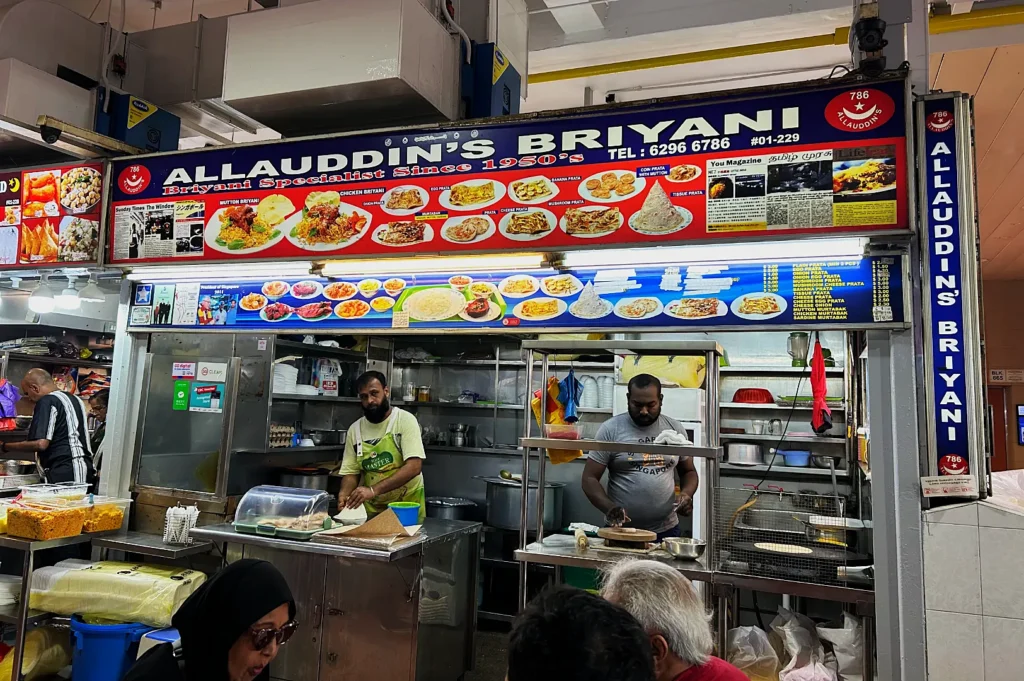
The stall does not announce itself with much fanfare. A worn counter. Trays of food behind glass, already glistening. Steel pots that have clearly seen years of service, their lids lifted and replaced in a rhythm that feels almost automatic.
Behind the counter, the men move without wasted motion, part of the steady choreography that defines Tekka Centre eateries. There is no performance here. Just hands that know exactly where the rice is, where the ladle goes, how much to scoop without thinking twice.
The Hum Around You
While you wait, the food court breathes around you. An uncle slurps teh tarik two tables over. A family argues gently over what to order. Trays clatter. Somewhere a phone rings and rings.
The line moves slowly, then suddenly. You shuffle forward. You watch the plate in front of you take shape.
The Plate Itself
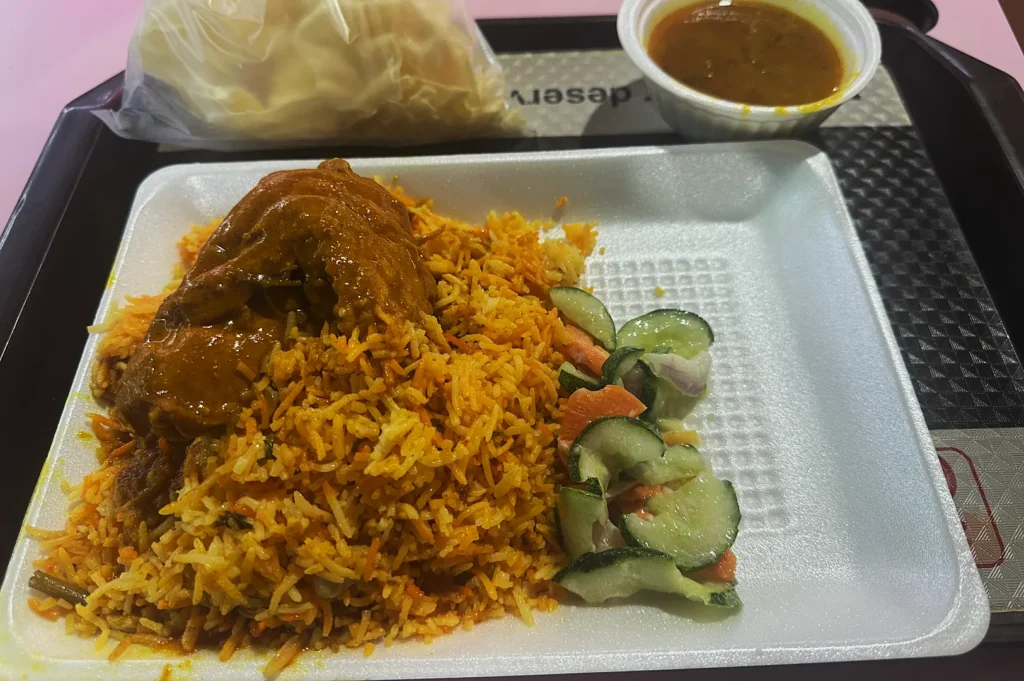
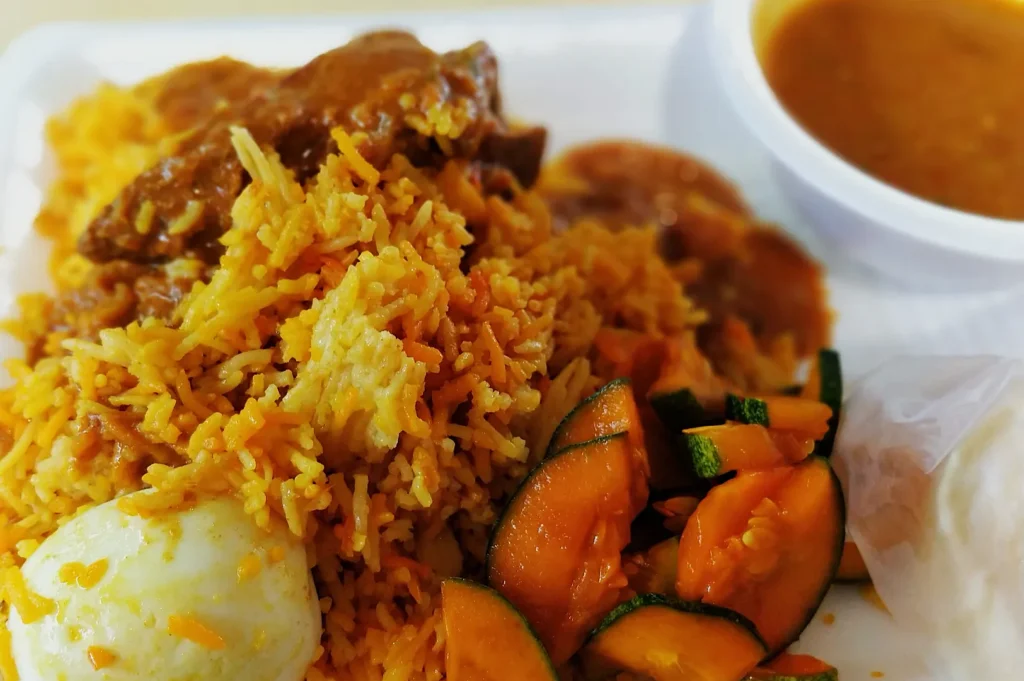
The rice comes first, long grains stained gold and brown, flecked with darker spice. It is not uniform. Some grains hold more color than others, and that unevenness feels right, like something cooked in a pot rather than calculated.
Then the meat. Mutton, usually, falling away from the bone with little encouragement. The fat has softened into the flesh. A ladle of dark, oily gravy follows, pooling at the edge of the rice.
The First Bite
You take a forkful before sitting down, the way people do when they have waited too long. The rice is warm and dense, each grain carrying the weight of the spice it cooked in. The mutton gives easily. There is heat, but it builds slowly, settling at the back of the throat rather than announcing itself.
A wedge of acar, sharp and crunchy, cutting through the richness. You reach for it more than once.
A Place That Has Stayed
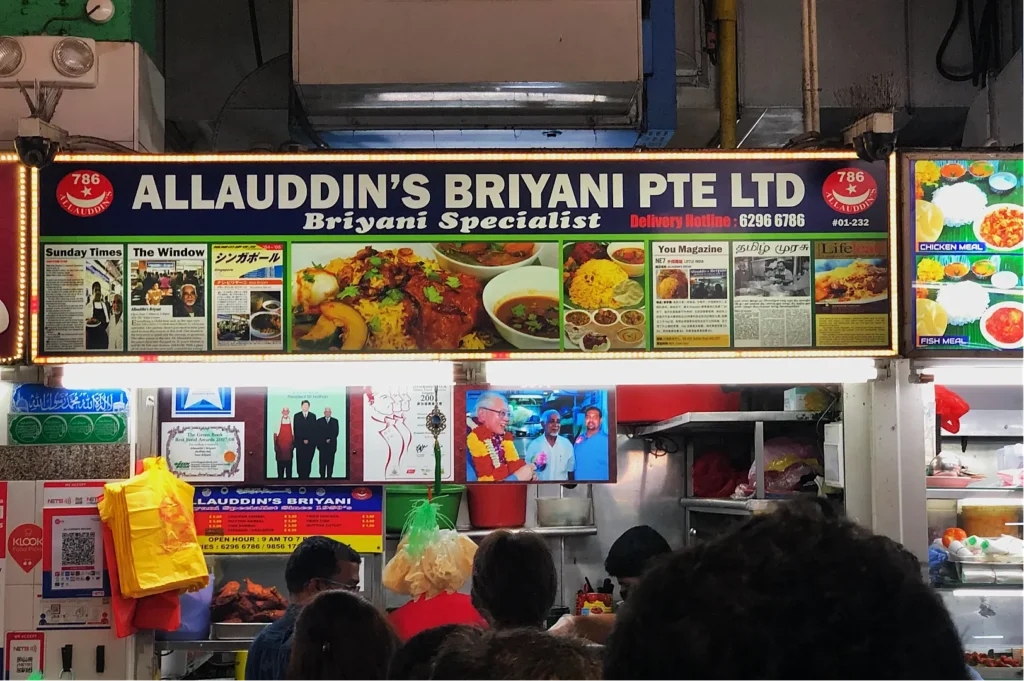
Allauddin’s has been part of Tekka Centre for decades. Generations have eaten here. The recipe has not chased anything. It has simply remained, plate after plate, served the same way to office workers, taxi drivers, families, and tourists who found it through word of mouth rather than a screen.
There is something steadying in that. In a city that knocks down and rebuilds, here is a pot of briyani that tastes much the way it always has. The people behind the counter have changed over the years, but the food carries the memory forward.
You see it in the regulars. They do not study the menu. They order in shorthand, nod once, and find a seat. This is routine for them. A meal they have eaten so many times it no longer needs thinking about.
The Last of the Rice
The plate empties slowly. The gravy thins out, soaked into what rice remains. You scrape the last of it together, more out of respect than hunger.
Around you, the food court keeps moving. Another tray clatters. The queue at Allauddin’s has not shortened. People will keep coming, the way they have for years, drawn by the same smell that pulled you in.
You leave full, and a little quiet. Back down the stairs, past the fish and the noise, out into the heat of Little India. The taste stays with you a while longer, the way certain meals do, long after the plate is cleared.